
Garden care · 6 min read
Light garden care through the year in Munich
Which garden task makes sense when, which deadlines apply and where the work of a cleaning company ends.
An article by MilieuLux · Audience: Garden
The article
A well-kept garden does not always call for a large landscaping contract. Many recurring tasks are smaller: mowing the lawn, gathering leaves, removing weeds, lightly cutting back shrubs and keeping paths clear. With this kind of work, timing matters more than the effort per visit — pruning in the wrong season costs the same hour and is still either harmful or simply not allowed. This article is built as a garden care year plan: ordered by season, with the deadlines set out in the Federal Nature Conservation Act and the hours the German noise protection ordinance permits for leaf blowers.
The garden year in four stretches
Spring usually brings clearing up, the first lawn care and the preparation of accessible areas. In summer, the rhythm of lawn and weeds is what counts. Autumn produces a great deal of leaves and garden waste. Winter clearing services, by contrast, are expressly not part of what MilieuLux offers. These stretches follow the weather, not the calendar page. Munich sits at a good 500 metres above sea level; growth starts later than in the river valleys to the west, and night frosts in the middle of May are not unusual. A trigger is therefore more reliable than a fixed date: the first cut is due once the blades stand eight to ten centimetres high.
Spring: let the ground dry before working it
The first rule in spring is patience with the soil. While the lawn is still saturated, every step compacts it — and those are exactly the spots that go bare in summer. Large parts of the city sit on the Munich gravel plain, whose gravelly subsoil lets rainfall drain away quickly; on loamy plots the same drying takes considerably longer. Scarifying, if it happens at all, comes after the second or third cut and only where moss is genuinely present. Before that, winter leaf litter comes out of beds and lawn edges: it has settled over the cold months and can be lifted in a single pass.
Summer: cutting height beats cutting frequency
In summer the lawn is mown more often, but rarely correctly. The rule of thumb is the one-third rule: no more than a third of the blade length comes off in any one pass. Cutting a ten-centimetre sward down to three centimetres in one go removes nearly all the green leaf; the area yellows and recovers more slowly than two shorter passes would have cost. In hot weeks a cutting height of four to five centimetres shades the soil and slows evaporation. For watering: once a week thoroughly rather than daily and superficially, and early in the morning, so the blades do not stay wet overnight.
Weeds in paving joints: why salt and vinegar are out
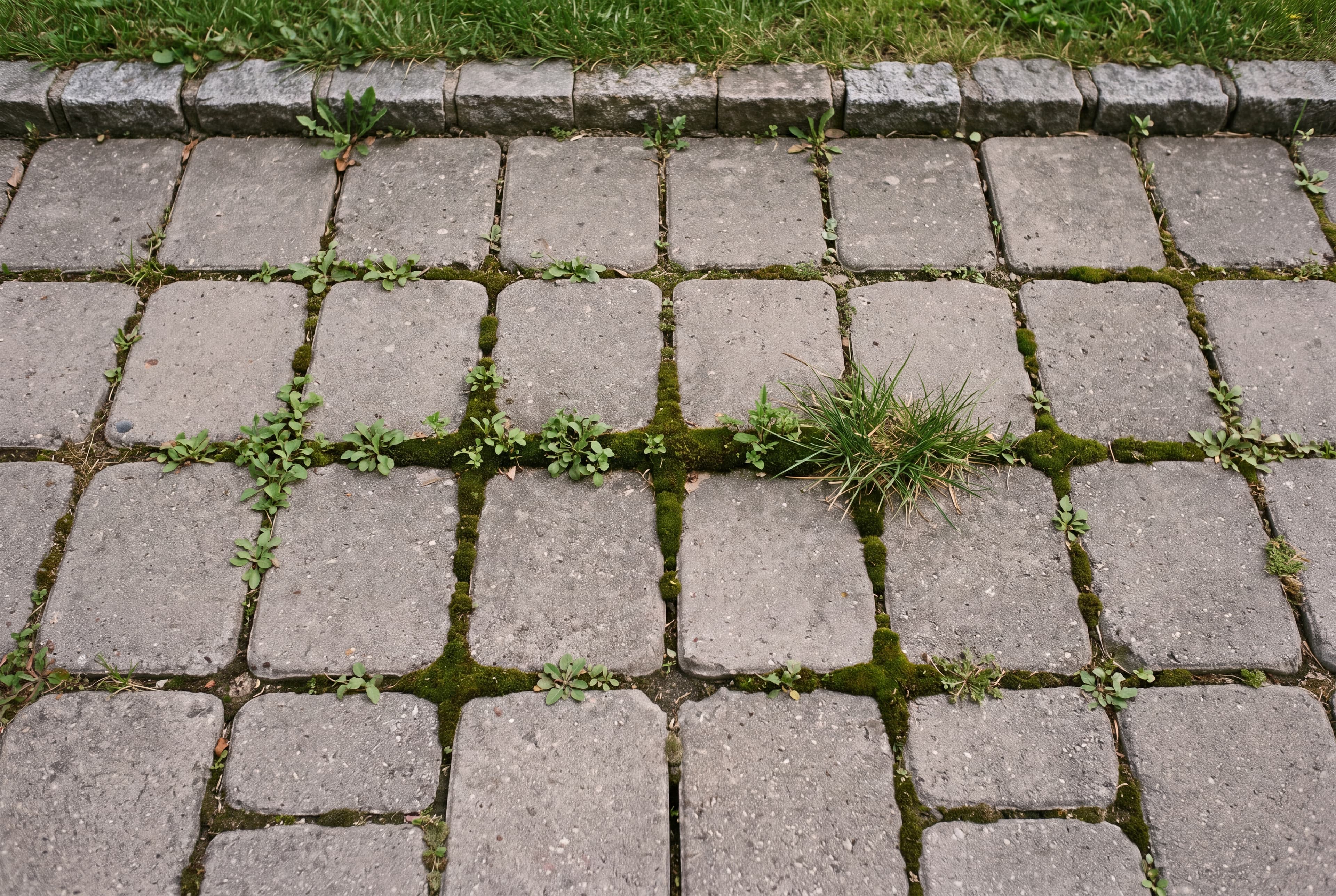
Weeds show first in paving joints — and are most often treated wrongly. In German law, household remedies such as vinegar or salt count as plant protection products. Applying them to sealed surfaces with no agricultural or horticultural use is not permitted without authorisation under the Plant Protection Act and counts as a regulatory offence. From a sealed surface the substance runs into the sewer instead of breaking down in soil. Mechanical work stays lawful and effective: joint scraper, wire brush, boiling water. The jointing sand that comes out has to be replaced — without it you are preparing the ground for the next growth and for slabs that start to shift.
Autumn: leaves do not have to go everywhere
In autumn the volume is the problem, not the work itself. On lawns the leaves have to come off: a closed layer takes light from the grass, holds moisture and encourages fungal damage, visible as pale patches in spring. Under hedges and around shrubs it may stay, where it acts as frost protection and largely breaks down by spring. For powered leaf blowers and leaf collectors in residential areas, the German equipment and machinery noise ordinance applies: they are permitted on working days only from 9 to 13 and from 15 to 17 hours, and not at all on Sundays and public holidays. Rakes and brooms are not subject to that restriction.
Pruning: plant, timing and law
Cutting back must suit the plant, the season and what is legally permissible. Tree felling and heavy work are excluded. Small tree stumps are only taken on after an inspection and where the work can be carried out safely without heavy specialist equipment. The decisive deadline is set out in section 39 of the Federal Nature Conservation Act: from 1 March to 30 September, hedges, living fences and thickets may not be cut back to the base or removed. Gentle shaping and maintenance cuts that limit the current year’s growth remain permitted. Shaping a hedge in June is therefore fine; halving its height means waiting until October. For trees above a certain trunk circumference, the city’s tree protection ordinance additionally requires a permit for work on the crown.
Paths and terraces: where garden meets cleaning
Garden and house meet at the terrace door. On north-facing sides and under trees, a greenish film of algae and moss forms on slabs and turns slippery when wet. The pressure washer is the obvious but frequently wrong choice: it flushes out the jointing sand, roughens cast stone and leaves timber decking fibrous. A soft brush worked along the grain suits wood, a brush with the right dilution suits slabs. Grit from the path, bark mulch and grass clippings stay in the first few metres behind the door; a long dirt-trapping zone and regular domestic cleaning on the ground floor catch most of it before it settles into carpet pile.
What happens to the green waste
With garden waste, volume drives the effort, not weight. Leaves and shrub cuttings weigh little but quickly fill several cubic metres; the organic waste bin of a terraced house is often full after the first hour of a larger autumn visit. The question of where the material goes therefore belongs before the appointment: into the existing bin, into bags you provide for later collection of your own, or taken away by us. The third route adds working time and possibly disposal fees. Burning is not an option inside the city. Shrub cuttings compact considerably if the branches are shortened to a uniform length before loading — uncut, the same quantity takes several times the load space.
On its own or alongside cleaning
Garden care can be requested on its own or together with a cleaning service. Billing is transparent, based on working time plus any disposal costs. Price on request. Price on request. We do not require a minimum order value; a single hour of mowing can be booked. Price on requestdeep clean of the house is due.
What is not included
A year plan is only useful if the gaps in it are named. MilieuLux does not carry out winter clearing, tree felling, pest control, façade cleaning or repairs to fences, irrigation equipment or machinery. We do not apply plant protection products. Work requiring climbing equipment, rope securing or a chainsaw above head height belongs with a specialist tree care firm. If such a firm is being engaged anyway, its visit is best scheduled before the leaf appointment — the cut brings another load of material onto the ground.
Six fixed points instead of twelve appointments
For most plots inside the city, a plan with a few fixed points is enough: one spring visit as soon as the ground has dried, two or three summer visits scheduled by growth rather than by date, one joint-clearing visit in early summer before the growth roots into the sub-base, one leaf visit after the main fall, which can go on the same day as the window cleaning, and one pruning visit from October onwards. A single pass after leaf drop takes less time than three passes in the middle of it.

Related questions
Are you allowed to cut a hedge in summer?
Between 1 March and 30 September only gentle shaping and maintenance cuts are permitted. A hard cut back or removing the hedge is not allowed in that period under the Federal Nature Conservation Act and is scheduled from October onwards. Nesting birds in the shrub mean we stop work at that spot, whatever the date.
How much garden waste fits into one visit?
That depends less on the quantity than on the route out. As long as the existing organic waste bin takes what accumulates, no further costs arise. If it is not enough, we agree beforehand whether you provide bags or we take the material away. Removal is charged by time; any disposal fees are shown separately.
Can garden work and cleaning take place on the same day?
Yes, and it is usually the sensible order of work: outside first, then inside. Price on request. Price on request.