
For your situation
Hotel cleaning service Munich and holiday lets
If you run a house with daily room turnover or let several apartments short term, you are not buying cleaning hours but reliability inside a tight window. A hotel cleaning service Munich operators can plan around therefore has to deliver two things: the same result whoever is on shift, and a message the moment something does not go to plan. This page sets out what you decide as an operator and what MilieuLux takes on.
Before hours are discussed, the turnaround window belongs on the table: the earliest release after departure, the latest point for the first arrival, and the minutes that pass in between for the status message. Selling late departures means selling cleaning time along with them – a single room vacated late costs the morning round one whole room. So tell us not only how many rooms there are, but how many units experience says will only come free around midday.
Why standardisation matters particularly here: in a private household the same person usually looks after the same rooms, and quirks even out over time. In turnover operation, by contrast, every member of staff makes the same small decisions afresh – how many towels per bed, where the hairdryer belongs, whether the remote control counts as a contact surface. Without a written rule you end up with twelve slightly different rooms. We record such points before the first assignment, because otherwise they are renegotiated every time staff change.
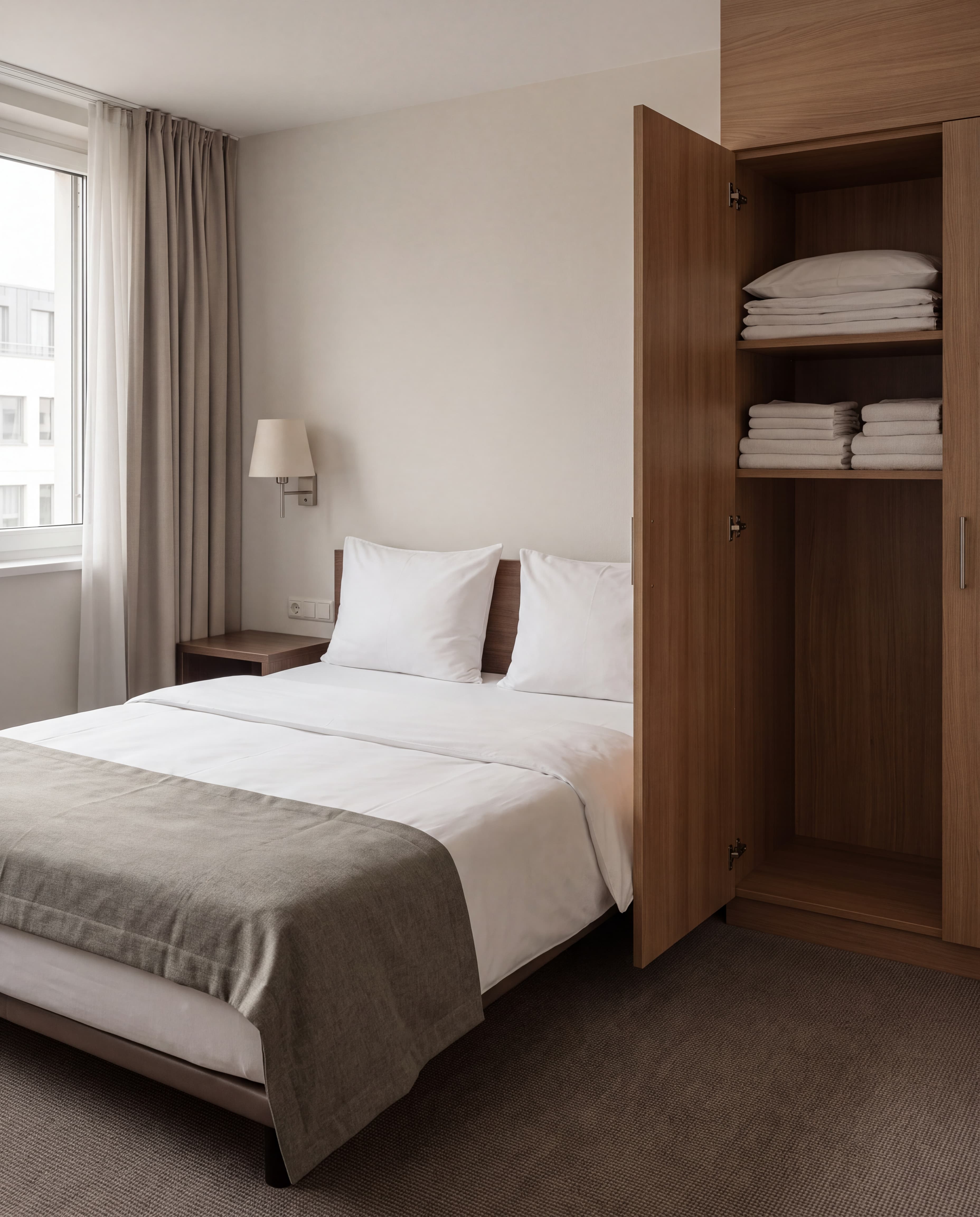
What matters to you
Typical properties
- City hotels of 10 to 60 rooms with a daily departure wave
- Serviced apartment houses with weekly and monthly guests
- Guest houses run by the owners themselves
- Single holiday flats in residential buildings without a reception
- Several short-let apartments under one management
- Seminar venues occupied only on course days
What matters to you
- Units finished before the first check-in, not in the evening
- The same execution regardless of who works the shift
- A check list that can be verified by spot check
- Access without anyone from your own team being present
- Damage and missing stock reported in writing the same day
- Extra staff during absences and peak weeks
- Billing by time rather than a flat rate per room
What matters here
What gets written down
A task list and a check list are not the same thing. "Clean the bathroom thoroughly" cannot be verified; "shower drain clear", "mirror edge free of smears", "spare roll present" can – each point has exactly two possible answers. Spot-checking two or three units per shift is then enough, provided it lands on different ones each time. It also matters who owns the list: it stays your document. If you change provider, the standard does not change with them.
For a firm quotation we need more than a room count: the room types, the usual ratio of departures to stay-overs by weekday, the type of bed, the bathroom fittings, and where the floor pantry sits and how it is stocked. A house without a staff lift loses walking time on every round that no floor-area figure will show. For apartments, add the storey, the lift and the parking situation. From those details comes a time range that also holds on the first visit.
How the linen circulates
With linen it is the circulation that decides, not the quality. Where laundering is done off site, three sets per bed is the workable size: one on the bed, one in the cupboard, one in transit. With two sets, every turnover day depends on a collection arriving on time. What comes out of a unit and what goes into it is recorded – without that evidence nothing can be claimed against a laundry later. We do not run a laundry of our own and do not broker one.
Access and damage reports
Access without anyone present is a question of organisation, not of trust. Inside a house we take cards limited to the relevant floors rather than a master card, issued and returned at one named point. For scattered apartments we keep an overview stating, for each property, which key or safe code applies, who last held it and when it came back. If you change a code, we need that change before the appointment – not while we are on the way.
Reporting damage is a procedure, not a remark in passing. What arrives on the day of the turnover can still be attributed to the last stay; what only appears in a weekly summary, in practice, cannot. We report to one fixed address, with the unit or room number, the time and a photo. You decide in advance what triggers a report and what is merely noted – a burn hole in a towel belongs in both categories depending on the house. Nothing is repaired.
What the invoice shows
Scattered apartments cost travel, and travel appears on the invoice. Travel costs arise per working day and per job, not per apartment and not per person. Anyone letting three units in neighbouring districts who aligns the turnover days pays them once instead of three times. That assumes the occupancy calendars are merged beforehand – bundled appointments rarely fail because of distance, usually because two booking portals are maintained separately. We need the dates as a list, not as a separate message per property.
Per-room flat rate or billing by time – the difference shows on the heavily soiled room. Under a flat rate the provider carries the time risk and has an incentive to speed up precisely where the work should take longer. We invoice the time actually worked on site, per person. That makes outliers visible instead of hiding them: if a shift regularly runs longer than planned, that points to the condition of the units, not to the person cleaning them.
Twelve departure rooms on a Tuesday, bathrooms with showers, beds with a single linen set. Two people work through the turnaround window together, four hours each, on one working day.
- Price on request
- Travel costs (1 working days)
- Price on request
- Price on request
Travel costs arise once for this working day, however many people attend. If two late departures are sold on that day, the invoice shifts through the number of hours, not through an additional base charge.
What a working hour means
Billing is per person on site and per hour worked. Two people working three hours makes six working hours.
Important limits
- No night shifts and no weekend shifts; assignments Monday to Friday from 08:00 to 20:00
- No reception duties, no guest communication, no till or minibar transactions
- Faults are reported, not fixed – no repairs and no trade maintenance work
- No pest control; where bed bugs are suspected a specialist firm is responsible
- No façade cleaning and no work on the outside of the building
- No winter clearing of entrances, driveways or parking spaces
- No specialist medical disinfection
- Assignments within the Munich city area only
Frequently asked questions
Is an external provider worthwhile alongside our own housekeeping?
Usually as an addition rather than a replacement: your own staff handle stay-over rooms and checks, we take the departure wave and the days when people are off. Price on request.
Can several holiday flats be combined into one day?
Yes, provided the turnaround windows fit together and the distances are short. Price on request. Send us the addresses and the earliest release times.
Who draws up the check list for our rooms?
We bring a template per room type; the decisions in it are your house rules – number of towels, how beds are aligned, where the hairdryer and iron are kept, how do-not-disturb signs are handled. It is only ever amended in writing.
Do you also work at weekends or overnight?
No. Assignments fall between 08:00 and 20:00, Monday to Friday. For houses with heavy weekend business that means we cover the weekday peaks, while the weekend stays on your own rota.
What happens if a guest complains about a unit?
Give us the room number and the date and we go through that shift’s check list and say which point was missed. Rework goes into the next free slot. If the same point recurs, we change the list – not the person.
Do you bill per room or by time?
By time. Price on request. We require no minimum volume. Price on request.

Matching services
Holiday apartment cleaning in Munich
Turnovers in a tight window – fresh linen, restocked supplies, photos at the end.
Washroom cleaning in Munich
Contact surfaces, ceramics and grout on a short cycle – with equipment that never leaves the washroom.
Floor cleaning in Munich
Every floor covering has its own rule – we establish it before the mop goes into the water.
Carpet cleaning in Munich
Carpets and carpeting cleaned gently – after checking fibre, backing and how they are laid.

Request a service plan
Describe your situation. We will get back to you personally with a reliable estimate.