
Services
Deep cleaning in Munich
When routine maintenance cleaning is no longer enough, the requirement deserves a closer look. A deep clean can cover floors, edges, hard-to-reach spots and soiling that has built up over a longer period. The exact scope is defined transparently in advance.
Deep cleaning, maintenance cleaning and post-construction cleaning are often lumped together, yet they are three different jobs. Maintenance cleaning preserves a condition already reached, working at short intervals with little dwell time. Post-construction cleaning removes the residues of building work: cement haze, adhesive, paint spatter. A deep clean, by contrast, recovers what months or years of normal use have built up. Order the wrong one and you either overpay or do not get what you expected.
A deep clean earns its place at turning points: before moving into a flat taken over from someone else, after a move-out, before a regular cleaning contract starts, after a longer spell standing empty, or when a room changes use. What these have in common is not the calendar but a condition that routine cleaning no longer corrects: grout stays grey, corners stay dull, and a floor looks used again shortly after it has been mopped.
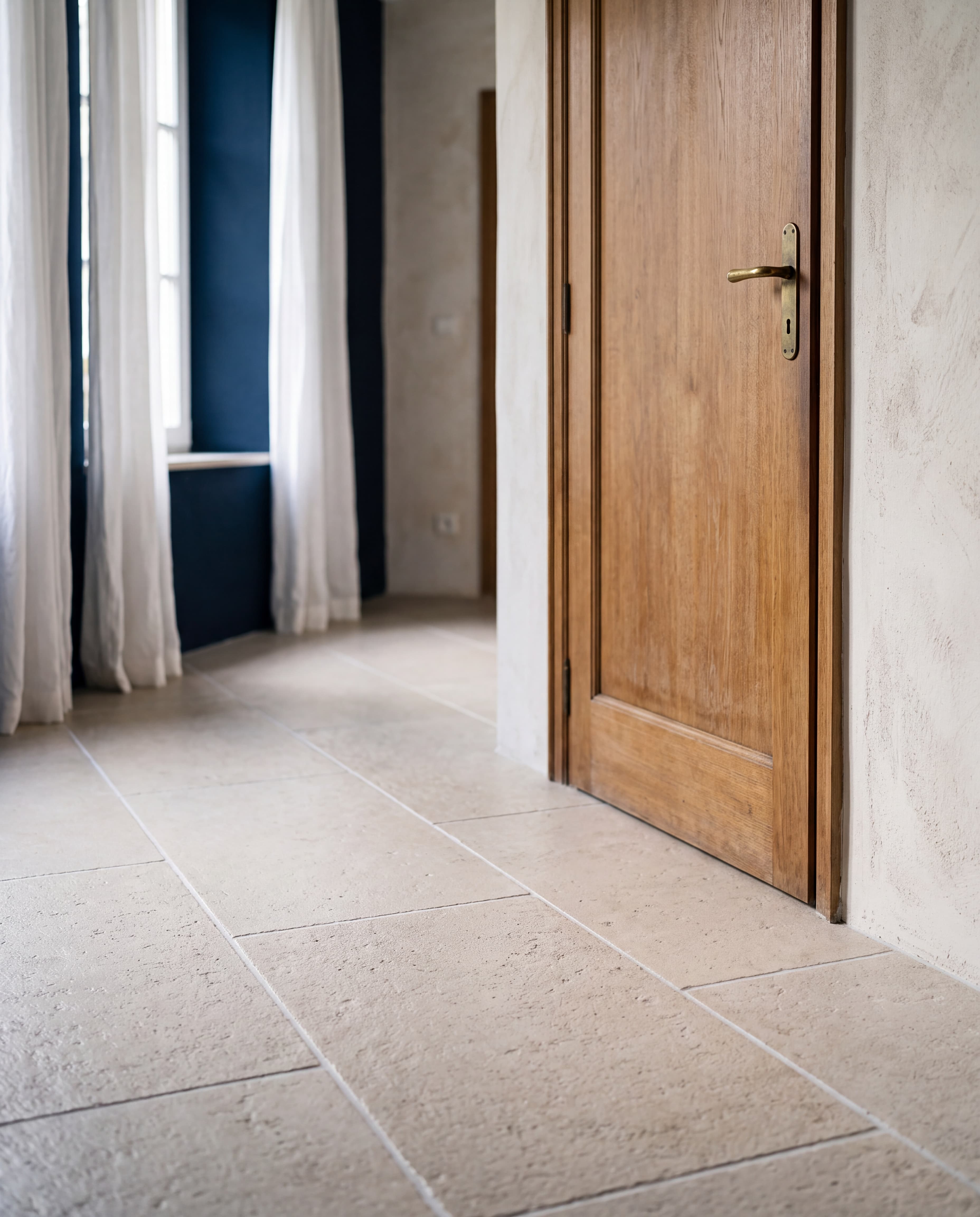
Typical work
Suitable for
- Flats before moving in or after moving out
- Offices and practices before a new cleaning contract
- Rooms left empty or rarely used for a longer period
- Kitchens and bathrooms with stubborn deposits
- Stairwells and shared areas in residential blocks
- Rooms about to change use
Typical work
- Intensive, material-appropriate floor cleaning
- Skirting boards, edges and corners by hand
- Lightening grout in bathroom and kitchen
- Dissolving limescale on fittings and shower screens
- Removing grease deposits from kitchen fronts
- Doors, frames, handles and light switches
- Radiators and accessible gaps between them
- Interior windows within safely reachable areas
Possible add-ons
- Oven, fridge and extractor hood interiors
- Wiping out cupboards once they are emptied
- Re-sealing elastic floors afterwards
- Carpet cleaning after a prior material assessment
Possible intervals
- One-off as required
- Before moving in or after moving out
- Once or twice a year
- Before a recurring contract starts
- At longer intervals by arrangement
What matters here
What the time depends on
The biggest procedural difference is dwell time. Encrusted soap residue, dried-on grease and limescale do not yield to more pressure but to time. An alkaline cleaner on a kitchen front needs several minutes before it is wiped off, depending on product and soiling; wiping immediately merely spreads the dirt around. So we work in waves: apply, move on, come back. It looks slow from outside and is faster overall than scrubbing three times.
Effort grows with the length of the edges, not with the floor area. An empty hall of a hundred square metres is done quickly; a hundred square metres of period building with skirting boards, door frames, radiator recesses, window reveals and a tiled bathroom contain many times the number of transitions, and that is exactly where the dirt sits. To estimate the time roughly, count the corners, edges and metres of grout rather than the square metres.
Grout and surfaces
Grout is the most common point of dispute afterwards, and that comes down to its surface: it is open, so soap residue and limescale draw into the material instead of sitting on top of it. Cleaning lifts what lies on the surface, not what has been drawing in for years. Where mould has grown right through silicone, cleaning is even the wrong measure: only replacement helps there, and that is a trade job outside our offer.
Coatings decide which product is permissible at all. Calcareous natural stone such as marble reacts to acidic descalers with dull etch marks that can no longer be wiped away. Anodised aluminium profiles on shower enclosures do not tolerate alkaline deep cleaners. Oiled floorboards lose their protective layer under a strong application and would then need re-oiling. So before mixing anything we establish which surface we are facing, and test in a concealed spot if the information is uncertain.
The old care layer
On resilient floors the term carries a narrower technical meaning: taking the old care layer off, down to the covering itself. On PVC, vinyl and linoleum, wax and polymer films build up over the years, trapping dirt and leaving the floor looking grey. That layer is released by machine, neutralised thoroughly and given a fresh care coating if wanted. Without neutralising, the residue binds dirt again straight away – this is the step most often skipped.
What we need beforehand
For a reliable quote we need more than the size of the property: the number and type of rooms, the flooring in each, how many bathrooms and WCs there are, when the last thorough clean took place, whether furniture stays in place, whether windows are included and whether water and power are available on site. If one of these is missing, we quote a range rather than a figure – and say what the outcome depends on.
The work follows a fixed order: dry dusting first, then top to bottom, floors last. Do the floor first and you do it twice. In practice that also means we need hot water, a socket within reach and somewhere to set down equipment and waste water. In empty flats none of this can be taken for granted, because power and water are often disconnected after a move-out. We settle that question when the appointment is booked, not at the front door.
What a site visit settles
What a site visit achieves shows in the third question, answered on site in minutes and never visible in a photograph: how many people can sensibly work alongside each other in a day. It depends on door widths, sockets, the water connection and where a wet surface may stay off limits for a while. That figure decides whether a job finishes in one day or two – and with it the travel costs.
Billing, and what follows
Price on request. A larger team pays off here more often than on recurring contracts, because dwell times run in parallel and everything is finished in a single working day. Afterwards we suggest moving to a fixed rhythm: holding the condition reached takes considerably less time than achieving it did.
Price
- per worker and working hour
- Price on requestper worker and working hour
- travel per working day — not per person
- Price on requesttravel per working day — not per person
- site visit, only if booked separately and without an order
- Price on requestsite visit, only if booked separately and without an order
What a working hour means
Billing is per person on site and per hour worked. Two people working three hours makes six working hours.
Assuming: A flat of 90 m² that has not been cleaned for a while – floors, edges, joints, kitchen and bathroom in one go.
- Price on request
- Travel costs, once per working day
- Price on request
- Price on request
A different property gives a different figure. The arithmetic stays the same.
How it works
Send your request
Choose whichever way of getting in touch suits you best.
Establish what is needed
We look at area, condition, timing, materials and any special requirements.
Confirm clearly
You receive a personal response and transparent terms.
Work to the list
We arrive at the confirmed time and work through the agreed service plan. If something does not get done, you hear it the same day.
Important limits
- Post-construction cleaning is a separate job with its own costing
- No façade cleaning and no façade work
- No repairs and no replacement of silicone joints
- No specialist medical disinfection without the appropriate qualification
- Age-related etching, scratches and material damage remain visible
We deliberately stay within our field. What we cannot carry out safely and properly, we decline in advance rather than promise.
Frequently asked questions
What is the difference between a deep clean and maintenance cleaning?
Maintenance cleaning holds a condition through short, recurring visits. A deep clean creates that condition in the first place and therefore works on the places routine cleaning skips: grout, edges, skirting boards, the backs of things and old care films on floors. It takes correspondingly longer and happens at wide intervals.
How long does a deep clean take?
That does not follow from floor area alone. What counts is the flooring, the number of bathrooms, the amount of edging and grout and the condition since the last thorough clean. An empty two-room flat is in a different bracket from an occupied space with furniture that has to be moved. Give us those points and you get a range with reasons attached.
Will the grout be white again?
Usually not completely. Cement grout absorbs pigments over the years that sit deep in its structure; it becomes noticeably lighter but rarely looks new. Where mould has grown through silicone, discolouration stays visible because the growth runs through the material. We say beforehand what result is realistic rather than explaining it afterwards.
Does the property have to be empty?
No, but empty is faster. Furniture that stays put hides surfaces and has to be moved to reach edges and skirting boards. We shift light furniture and put it back; heavy cabinets and plumbed-in appliances stay where they are. Clearing surfaces in advance noticeably reduces the time needed.
Do I need a site visit first?
Not necessarily. Where a job can be described clearly, photos plus details of rooms and flooring are enough. A visit makes sense when sensitive materials are involved, the condition is unclear, or many different floor coverings come together. Price on request.
Do you also clean straight after building work?
That is a different job. Post-construction cleaning removes cement haze, adhesive residue and paint spatter, and calls for different products, different protective measures and its own costing. Deep cleaning follows on once the coarse building debris has been cleared. Tell us which case applies and we will sort it out in the first conversation.
Which products do you use?
We choose by surface, not by habit: alkaline against grease and old care films, acidic against limescale, neutral on sensitive coverings. Professional cleaning systems, such as those from Dr. Schnell, cover that range. What matters is dosage, dwell time and picking up all the dirty water – if residue is left behind, the floor looks dull again within days.

Goes well with
Household clearance in Munich
Clearing a home completely – with papers secured, decisions agreed and receipts for the disposal.
Vacant property cleaning in Munich
Getting long-unused rooms presentable again – in good time before the viewing appointment.
Special cleaning in Munich
Jobs that fit no standard line item – assessed first, then accepted or declined with reasons.
Upholstery cleaning in Munich
Sofas, armchairs and mattresses – cleaned according to what the cover can actually take.
Who we typically do this for

Talk to us
Tell us the area, the condition and your preferred date. We will get back to you personally with a reliable estimate – usually the same day during our availability hours.