Pricing · 5 min read
Understanding cleaning costs
What a cleaning invoice is made of, why floor area is the weakest clue, and how to put two quotations on the same footing before you compare them.
An article by MilieuLux · Audience: Everyone
The article
Anyone comparing quotations looks first for a price per square metre and finds cleaning costs per hour instead. That is not evasion, it is the more accurate measure. The price of a clean does not depend on square metres alone. Two flats of identical size can require completely different amounts of time. Furnishing, soiling, the number of bathrooms and kitchens, windows, floors, accessibility and unusual residues change the effort considerably. This article explains which items an invoice actually contains, and how to spot two quotations that only appear to be comparable.
Why floor area is the weakest clue
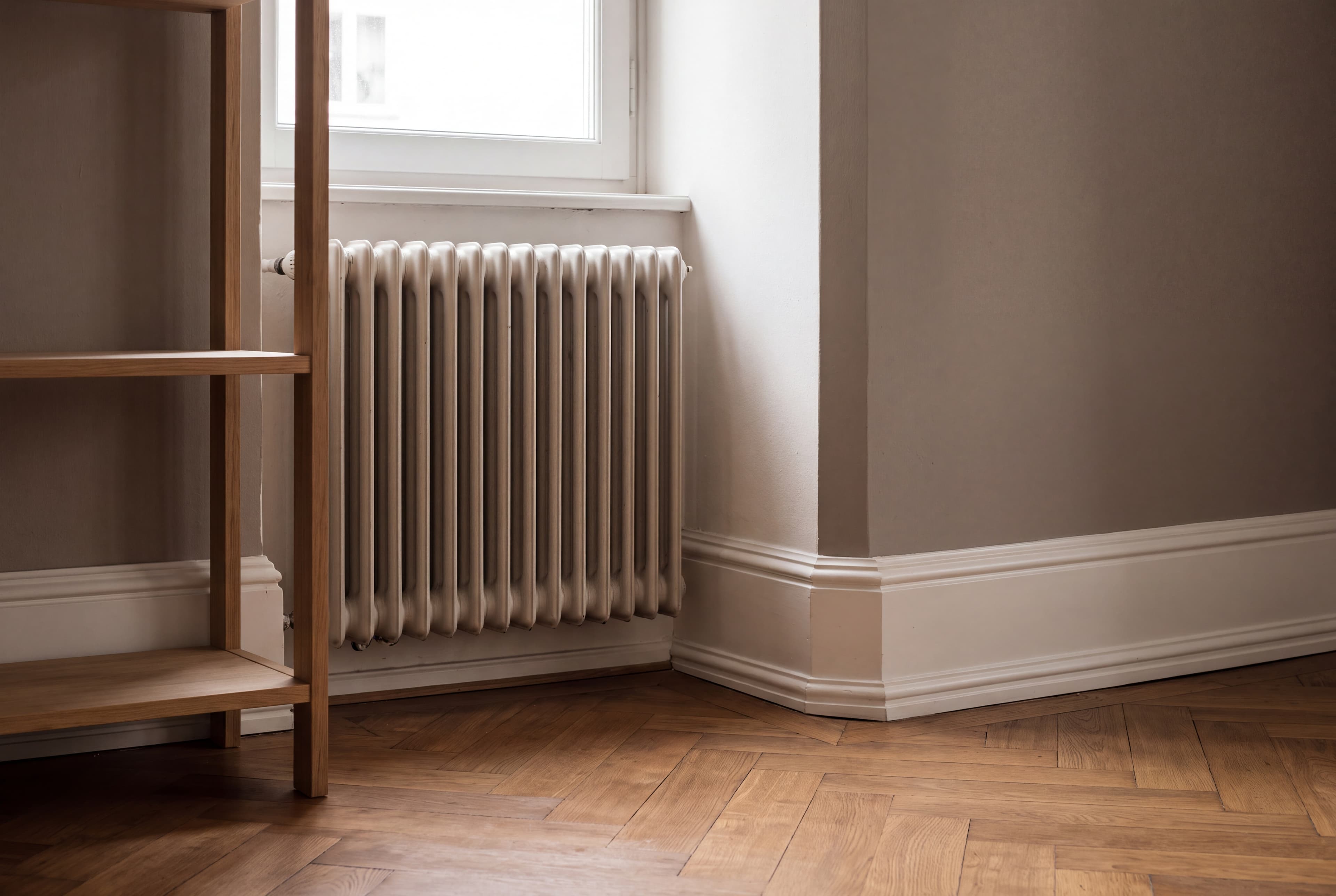
Time is spent at edges, not on open surfaces. A cleared room is mopped in minutes; the same area with shelving, chair legs, skirting boards and radiators takes several times as long, because every object has to be worked around. The number of rooms therefore says more about the effort than the sum of their square metres. The second driver is wet areas: bathrooms and kitchens cost considerably more time per square metre than living and sleeping rooms, because limescale and grease need dwell time and will not yield to pressure. A smaller flat with two bathrooms outweighs a larger one with a single bathroom. The third driver is the number of floor coverings. Every additional covering means changing product, dosage and mop head, and that change costs minutes which appear on no per-square-metre calculation.
What the invoice is made of
MilieuLux therefore works with visible hourly rates. Price on request. If you provide suitable products of your own, no material costs from MilieuLux arise for them. Disposal costs are not a mark-up but a pass-through item: they follow the quantity and waste fraction accepted by the facility in question and are passed on against the receipt. On any quotation, check first whether working time, travel, and materials and disposal are itemised separately at all. If one of them disappears into a single total, there is no way afterwards to see why one invoice came out higher than the last.
A working hour is not an hour on site
What matters is the meaning of working hours: if two people work for three hours, six working hours arise. This is set out plainly on the website so that no misunderstanding can occur. This is where most false comparisons begin. Where a quotation names a number of hours, ask how many people stand behind it: a two-person team is finished on site after three hours and has still performed six working hours. A rate that sounds lower can end up costing more if it refers to the appointment rather than to the individual worker. For one-off jobs such as a deep clean of an entire flat, by contrast, a larger team often lowers the total, because the travel flat rate arises only once and the waiting time while products act is used on other rooms.
Travel costs arise per working day, not per person
Price on request. Whether one person or three make the journey changes nothing. In practice: split three small jobs across three appointments and you pay the flat rate three times; put them on one working day and you pay it once. Conversely, two separately commissioned jobs remain two jobs even at the same address — a flat and the stairwell of the owners association, say, which have different invoice recipients. On recurring work such as the regular cleaning of office premises, look at the year rather than the single visit: a fortnightly cycle produces twenty-six working days and therefore twenty-six of these items. There is no minimum order value, so a single short visit is possible — the journey simply weighs more heavily within it.
Flat rate or hourly rate
A flat rate is neither dearer nor cheaper than an hourly rate; it merely shifts who carries the risk. Whoever names a fixed sum has to price in the worst case, or pay for it themselves. Where tasks are clearly describable and stay the same, that works out. Where the condition is unclear, the flat rate contains a surcharge for uncertainty that twenty minutes on site would resolve.
What private households can claim against tax
Under section 35a, German income tax law grants a reduction for household-related services such as the domestic cleaning of your own home. Labour and travel costs qualify, material costs do not — another reason to itemise these blocks separately on the invoice. Two formal conditions decide recognition: an invoice must exist, and the amount must be paid by bank transfer rather than in cash. The tax office does not accept a cash payment even when a receipt exists. Anyone wanting to use the reduction therefore transfers the money and keeps the bank statement. The maximum amounts, and the line between household services and tradesman services, are set out in the statute; whether and to what extent they apply to you is a question for your tax adviser. Tenants, incidentally, will already find some such services in their annual service charge statement.
When a site visit costs less than an estimate
The digital estimating tool asks for the key time factors and shows a non-binding range. For complex tasks, a personal assessment or site visit remains the most reliable basis. Price on request. It pays off wherever photographs cannot show the decisive dimensions: the depth of a pile, the state of a joint beneath the limescale, the width of a door and stairwell, or the route from the parking spot to the flat door. An empty, clearly described property, on the other hand, needs no preliminary visit. More useful then are pictures taken at eye level rather than from the doorway, together with the number of rooms, window sashes and floor coverings, plus the storey and whether there is a lift.
Estimating the effort yourself
A sheet of paper is enough for a first estimate of your own. Note down for each room what actually needs doing, separating standard tasks from occasional extras such as windows, the insides of cupboards or the fridge. Count window sashes rather than windows: a three-sash element is three operations, inside as well as out. Record just as carefully which surfaces are expressly not to be touched — a short exclusion list shortens the time more effectively than any haggling over the rate. After the first appointment you hold a dependable figure: the working hours actually performed. Only that figure is fit to build a rhythm on. If it drifts persistently, that is a reason to change the scope, not to carry it on unspoken.
What price comparisons often overlook
Two quotations are comparable only if they describe the same scope. MilieuLux works exclusively within the Munich city boundary, which keeps journeys predictable; providers covering a wide catchment area calculate this item differently. Façade cleaning, winter service, pest control, repairs and trade maintenance work are not part of the offer. If one of those items appears in a competing quotation, you have two different services side by side rather than two prices for the same one. Ask as well about the time window in which work takes place: our appointments fall Monday to Friday between 08:00 and 20:00, and anyone needing off-peak hours or weekends should settle that early rather than give it up while comparing totals.

Related questions
Why do you not quote a price per square metre?
Because floor area predicts the time required only weakly. A per-square-metre price would have to price in the worst condition and would be set too high for well-kept, sparsely furnished rooms. The working hour, by contrast, reflects exactly what was actually done.
Can an invoice exceed the range you quoted?
A range is an estimate, not a commitment. If it turns out on site that more time is needed, we say so during the visit and not first on the invoice. Whether we carry on or move the rest to a second appointment is your decision.
How do I tell whether a quotation hides ancillary costs?
Look for four details: how many people per visit, the hours assumed, how travel is handled, and how materials and disposal are treated. If one is missing, the total cannot be verified. Ask in addition whether travelling time is billed as working time.