
Services
Glass cleaning in Munich
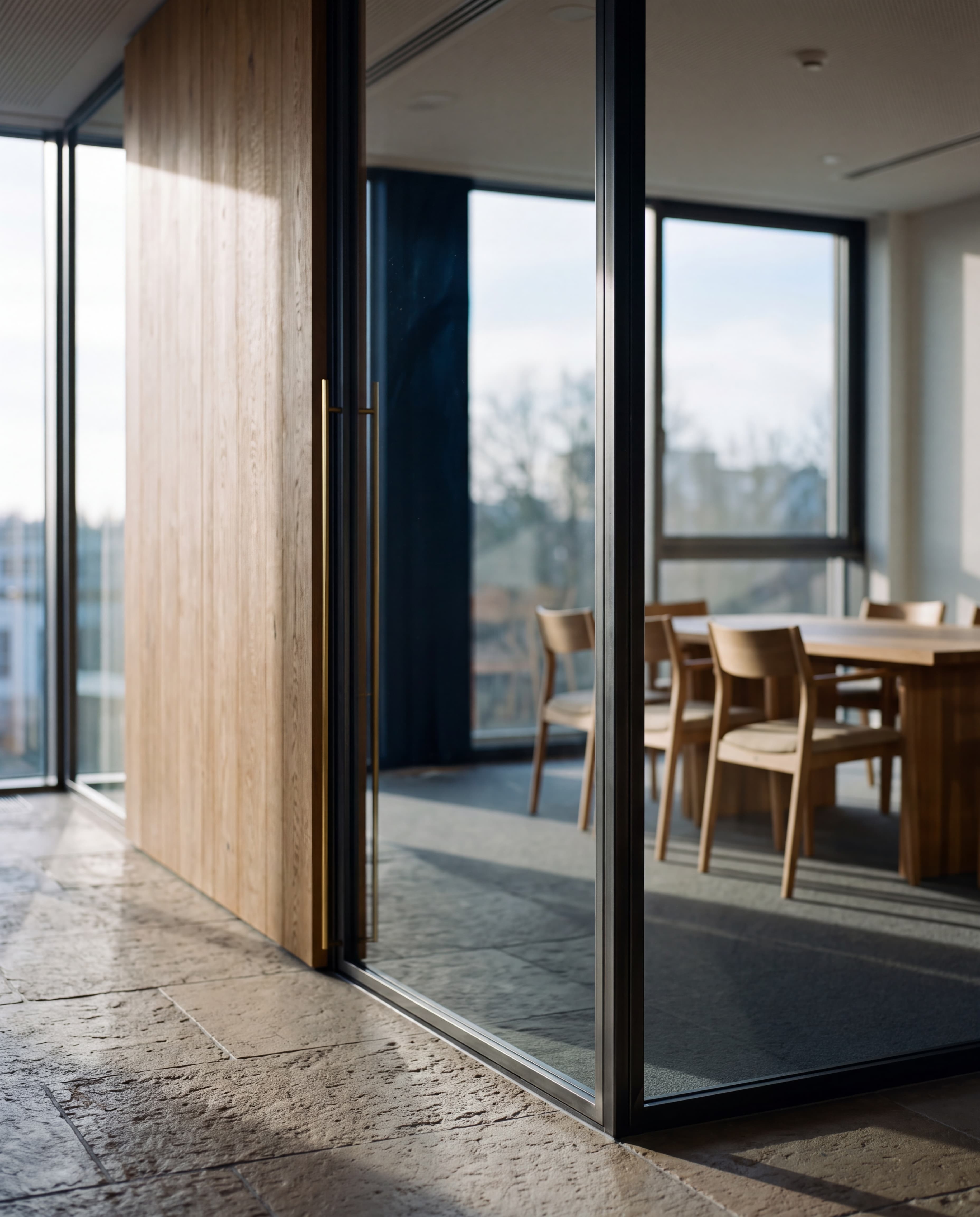
Glass doors, partitions and display cases show every handprint the moment light falls across them at an angle. Our glass cleaning in Munich is aimed at these commercial surfaces: full-glass elements, sliding door systems, retail cabinets and privacy glazing, together with their fittings. Domestic windows are not part of it – that is what window cleaning is for. How often a surface comes round depends on who touches it.
Glass within reach gets dirty at an entirely different rate than the area above it. A full-glass door at reception is touched in the same spot hundreds of times a day, and its lower zone also catches shoe marks and splashes from mopping. Above head height, by contrast, nothing happens for weeks. So we set separate frequencies for these zones instead of touching every pane equally often.
A fingerprint is grease, not dust. Rubbed off dry it merely spreads further, and raking light shows that immediately. We therefore wet the surface with a surfactant solution – products from ranges such as Dr. Schnell – and lift it off in a single pass. A spray bottle and cloth are fine up to about the size of a display cabinet; on a full-glass element over two square metres, alcohol-based cleaner dries on before the surface is finished.
Typical work
Suitable for
- Offices with glass partitions and full-glass doors
- Reception and waiting areas
- Retail spaces with display cases and counters
- Law firms with glazed meeting rooms
- Practices with glazed reception areas
- Studios with glass and mirror walls
Typical work
- Cleaning full-glass doors on both faces
- Glass partitions within reach
- Wiping pull handles, locks and clamp fittings
- Display cases and counters from outside
- Interior glazing wherever reachable from the floor
- Dry finishing of silicone joints and edges
- A final check in raking light
Possible add-ons
- Display cases from inside once emptied beforehand
- Interior glass balustrades and parapets
- Sticker residue on clear glass after a material check
- Mirror surfaces in washrooms and changing areas
- Fixed intervals for the areas within reach
Possible intervals
- Weekly for the reach zone of heavily used doors
- Several times a week where there is public footfall
- Monthly for partitions in offices
- Quarterly for high surfaces and transom lights
- One-off after a refit or ahead of an event
What matters here
Fittings and display cases
The fittings take more time than the glass itself. Pull handles, clamp fittings and locks on full-glass doors are usually brushed stainless steel with a visible grain direction: wipe across it and the marks stay put. Chlorine-based and abrasive products have no place on that surface. Floor springs collect dust in their recess, which turns into a tide mark once it gets wet – so we vacuum them out first.
We do not spray into an open display case. The mist settles on the goods and the glass shelves and leaves haze exactly where the eye lands. Instead we dampen the cloth outside the cabinet and work from top to bottom. We switch the cabinet lighting off, because warm glass dries the solution on before it can be lifted away.
Etched glass and films
Etched glass and privacy films call for a different approach than clear glass. Etched surfaces absorb skin oils rather than repelling them; a handprint shows up dark there and stays that way if oil- or wax-based products have been used. Films are softer than the glass beneath them and lift at the edges as soon as solution is left standing there. We check the edge to see what has been installed and work on both without a blade.
What determines the effort
Square metres say little when it comes to a reliable quote. What matters is the number of elements, whether both faces are accessible, how high the top edge sits and how many joints with silicone seals run between them. Solution collects in those joints and runs back across the dry pane as a streak after the squeegee pass, so every joint needs a dry follow-up.
Price
- per worker and working hour
- Price on requestper worker and working hour
- travel per working day — not per person
- Price on requesttravel per working day — not per person
- site visit, only if booked separately and without an order
- Price on requestsite visit, only if booked separately and without an order
What a working hour means
Billing is per person on site and per hour worked. Two people working three hours makes six working hours.
Assuming: A shopfront with 18 m² of glass, both sides, reachable from the ground – every two weeks.
- Price on request
- Travel costs, once per working day
- Price on request
- Price on request
A different property gives a different figure. The arithmetic stays the same.
How it works
Send your request
Choose whichever way of getting in touch suits you best.
Establish what is needed
We look at area, condition, timing, materials and any special requirements.
Confirm clearly
You receive a personal response and transparent terms.
Work to the list
We arrive at the confirmed time and work through the agreed service plan. If something does not get done, you hear it the same day.
Important limits
- No façade cleaning and no façade work
- No work at height, aerial platforms or rope access
- No blade on etched, filmed or coated glass
- Scratches, glass corrosion and dulled zones remain visible
- No maintenance work on fittings, hinges or door closers
We deliberately stay within our field. What we cannot carry out safely and properly, we decline in advance rather than promise.
Frequently asked questions
What does cleaning a glass partition cost?
Price on request. There is no minimum order value. Price on request.
How often should glass doors and partitions be cleaned?
Zone by zone. Where there is public footfall, the reach zone of heavily used doors needs weekly visits; in offices, usually every two weeks. Surfaces above head height are fine quarterly. After the first visit we propose a rhythm based on how often the doors are used.
Are our office windows included as well?
No, window cleaning covers those: a window adds the frame, the sill and the rebate, none of which a partition has. If both are due, we bundle the appointments onto one working day so the travel charge only applies once.
Do you clean display cases on the inside too?
Yes, provided the interior has been emptied beforehand. We neither remove nor replace goods and display items – otherwise liability for breakage and for the arrangement would be unclear. Glass shelves we lift out where they simply rest on their supports without tools.
Can you remove scratches and dull patches?
No. Scratches are lost material, and dull zones around handles are usually an abraded surface. Both remain visible after cleaning, and glass polishes take away further material. We tell you before the appointment which marks are permanent.
Goes well with
Law firm cleaning in Munich
Cleaning in law firm premises with a settled team, a clear room list and distance from files and client appointments.
Medical practice cleaning in Munich
Hygiene-conscious cleaning with clear arrangements and reliable time slots.
Stairwell cleaning in Munich
Stairwells, handrails and entrance areas at fixed intervals – agreed with your property manager.
Window cleaning in Munich
Glass, frames and rebates – inside and out, wherever they can be reached safely.
Who we typically do this for

Talk to us
Tell us the area, the condition and your preferred date. We will get back to you personally with a reliable estimate – usually the same day during our availability hours.