Cleaning · 5 min read
Cleaning products and sensitive surfaces
Why the choice of product decides the condition of a surface – and how to tell in advance.
An article by MilieuLux · Audience: Everyone
The article
A powerful product is not automatically a good one. Natural stone, wood, coated surfaces, textiles such as carpets and delicate fittings all react differently. Correct dilution and a material check matter more than aggressive application. Anyone wanting to know which cleaning products sensitive surfaces cannot take will rarely find the answer on the front of the bottle: it names the soil a product dissolves, not the substrate it alters along the way. The useful details are in small print on the back or in the manufacturer’s technical data sheet.
pH direction tells you more than the product name
Almost every cleaning task comes down to one of two directions. Acidic products dissolve mineral soil: limescale, urine scale, rust film. Alkaline products dissolve organic soil: grease, protein, hand perspiration. That is why a bathroom cleaner achieves almost nothing against the greasy film above a cooker, and a degreaser will not clear a shower head. The pH value is printed on professional containers or given in the data sheet, usually for the ready-to-use dilution rather than the concentrate. Reading that single figure means deciding before the job, not afterwards.
Aluminium, zinc and seals do not tolerate extremes
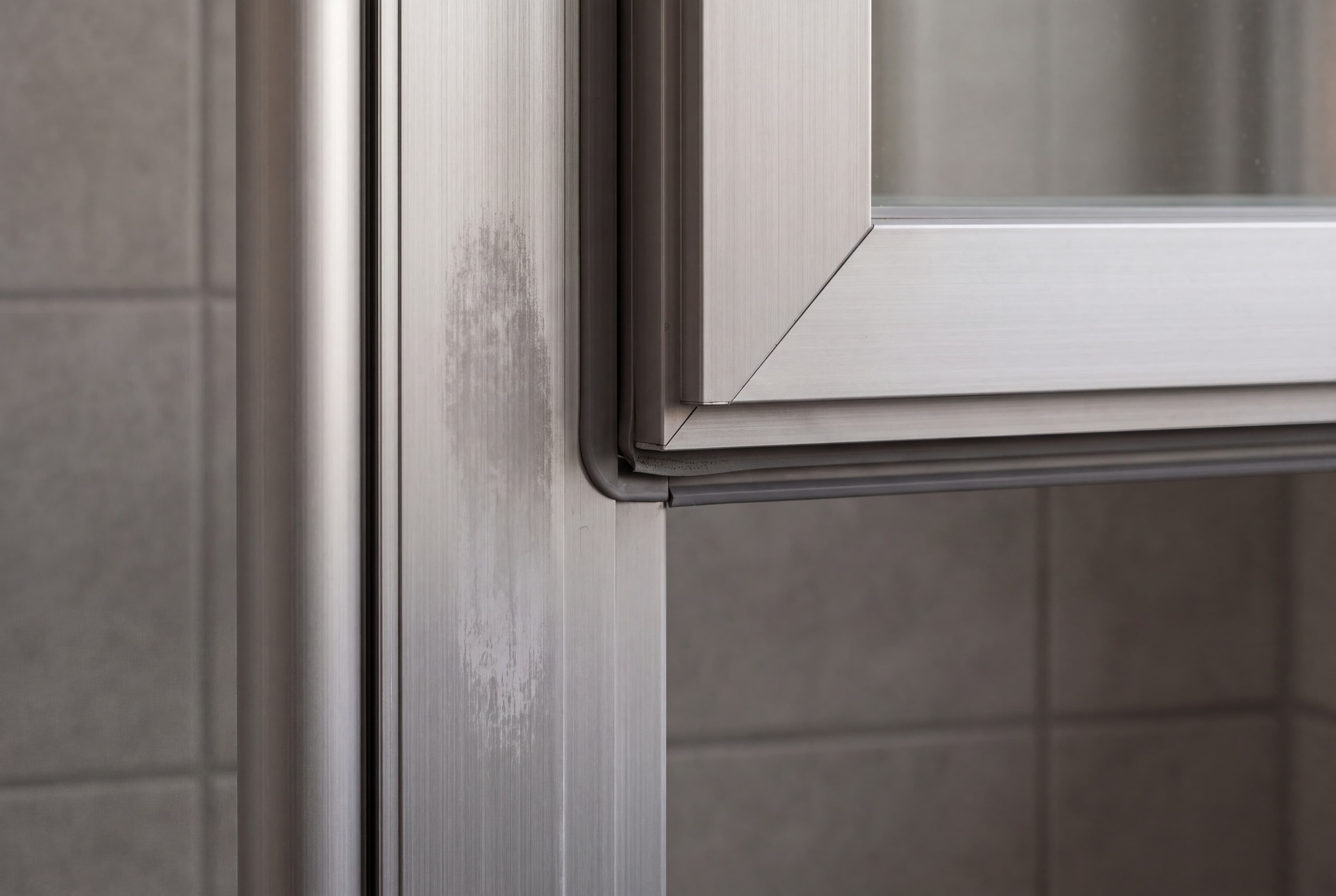
Two groups of materials are almost always overlooked. Bare and anodised aluminium – window frames, shower profiles, lamp parts, portafilters – cannot take strongly alkaline deep cleaners: the protective oxide layer dissolves and leaves grey, dull patches that no polishing brings back. Galvanised parts behave similarly. Rubber and silicone seals, in turn, swell under sustained acidic or solvent-based exposure, first going soft and later cracking. Neither happens the first time; it builds up over months – which is precisely why it is rarely connected to the product used.
Time and mechanical action replace harshness
In professional cleaning, Sinner’s circle describes four variables that together produce the result: chemistry, mechanical action, temperature and time. Reduce one and another has to increase. That is exactly where the room for manoeuvre lies with sensitive surfaces: instead of dosing more strongly, you let the product dwell longer or work a little more thoroughly with a suitable cloth. The one rule is that nothing may dry on – dried cleaner residue leaves rings that take more time to remove than the original soil did. So no work on sun-warmed glass.
Which product suits which surface
MilieuLux uses professional products chosen to suit the material and may, for example, work with products by Dr. Schnell. Which product actually fits depends on the surface, the soiling and the hygiene requirement. Professional products come with a technical data sheet stating dilution, dwell time and material compatibility, plus a safety data sheet with the hazard information. Anyone decanting concentrate into a spray bottle has to label it with the product name and hazard symbol. Drinks bottles are ruled out for this, even for the length of a morning.
The concealed test patch
Before using an unfamiliar product on a sensitive surface for the first time, it pays to test where nobody looks: behind a door, under a piece of furniture, in the plinth area, on the inside of a cabinet front, on the back of an upholstered sofa or armchair. Do not judge immediately but after the spot has dried completely, because a loss of gloss only shows then. Grazing light helps: looking flat across the surface reveals veils, wipe marks and fine dulling that stay invisible under direct light. A photograph of the original condition settles any later question about what was already there.
Your own products – and why we still ask
You are welcome to provide your own products. What matters is a clear description of where and how they are to be used. Where a risk is apparent, we ask before applying anything. The most important of those cases is mixing: chlorine-based cleaners combined with acidic descalers release chlorine gas, which irritates the airways even in small amounts. It is enough to use both products on the same surface in quick succession without rinsing with clear water in between. Products therefore stay in their original containers and are used one at a time.
Household remedies: useful, but not everywhere
Vinegar and citric acid work against limescale, but they are acids with the same side effects as any acidic bathroom cleaner – on lime-bearing stone, on aluminium and on seals they cause damage. Bicarbonate of soda and cream cleansers work mechanically: on acrylic baths, ceramic hobs, high-gloss fronts and painted surfaces they leave a web of fine scratches that makes the surface look permanently dull. The same applies to the melamine foam eraser, which is not a sponge but a very fine abrasive. Washing-up liquid, meanwhile, leaves a dust-attracting film on glass.
The cloth matters too
Microfibre picks up soil mechanically and therefore needs less chemistry – as long as the cloths are looked after. Fabric softener settles into the fibre and reduces its effect; washed too hot, many fibres fuse for good. Neither is visible on the cloth, only in the result. Professional cleaning also separates cloths by colour, typically one colour each for washrooms, kitchens and remaining areas, which stops germs travelling from one area to the next on the cloth. With pads for machine floor cleaning the rule is simple: the darker the pad, the more aggressive it is.
Hard water in Munich
Munich’s drinking water comes mainly from the Mangfall and Loisach valleys and is correspondingly rich in lime. For sensitive surfaces that has two consequences. First, practically every droplet dries into a visible mark, especially on glass shower screens, taps and dark tiles; a squeegee after showering prevents more deposit than a descaler can later remove. Second, hard water binds part of the surfactant, so under-dosing cleans worse than expected – dosage figures for professional products always refer to a particular water hardness range.
What we should know beforehand
Please mention allergies, pets or sensitive areas in the enquiry form. That allows the work to be prepared instead of improvised later. In practice this means fragrance-free products where scents are a problem, avoiding products containing essential oils in homes with cats, a clear-water pass on floors where animals lie, and no spray mist in rooms with an open aquarium – there the product goes onto the cloth rather than into the air. Such requirements cost no extra time when they are known in advance.
Where cleaning ends
One distinction at the end saves a great deal of frustration: material damage is not dirt. An etch mark in marble, a rubbed-through coat of paint, a swollen board edge or a seal gone porous stay visible after even the most careful cleaning; they belong to the relevant trade. Separating the two early spares you the attempt to rescue with an even harsher product something that has nothing to do with chemistry. In case of doubt, the smaller measure is the right one: check first, then choose the mildest method that does the job.
Related questions
How do I tell whether a product is acidic or alkaline?
Most reliably from the pH value stated on the container or in the data sheet. If it is missing, the purpose gives it away: descalers and bathroom cleaners are almost always acidic, degreasers, deep cleaners and oven sprays alkaline. A claim of neutrality refers to the diluted working solution, not to the concentrate in the bottle.
What should I do if the wrong product has already been used?
Take the product up at once with plenty of clear water, dry the surface and only then judge it under grazing light. Never follow up with something harsher – that usually just enlarges the affected area. Take a photo and note the product name; we need both to judge whether any follow-up treatment makes sense at all.
Do we need to have our own products ready for an appointment?
No, we bring suitable products with us. Price on request. It helps if the product name and the intended surface are known in advance – then compatibility is settled before the appointment rather than on your wall.