
Services
Floor cleaning in Munich
Floor cleaning Munich starts, at MilieuLux, with a question about material. Parquet, natural stone, vinyl, linoleum and tiles all look alike on a list of services, yet they tolerate different products, different amounts of water and different mechanical action. We identify the covering and its finish before the mop goes into the water. Those few minutes are well spent: the wrong product leaves damage that no later cleaning undoes.
With parquet it is the finish that matters, not the species of wood. Sealed parquet carries a closed film of lacquer and is only wiped with a barely damp mop; standing water runs into the joints between boards and swells the edges. Oiled parquet has no film, only saturated pores – all-purpose cleaners high in surfactants wash the oil out and the surface goes patchily dull. A drop of water in a hidden spot settles the question: if it beads, the floor is sealed; if the wood darkens, it is oiled.
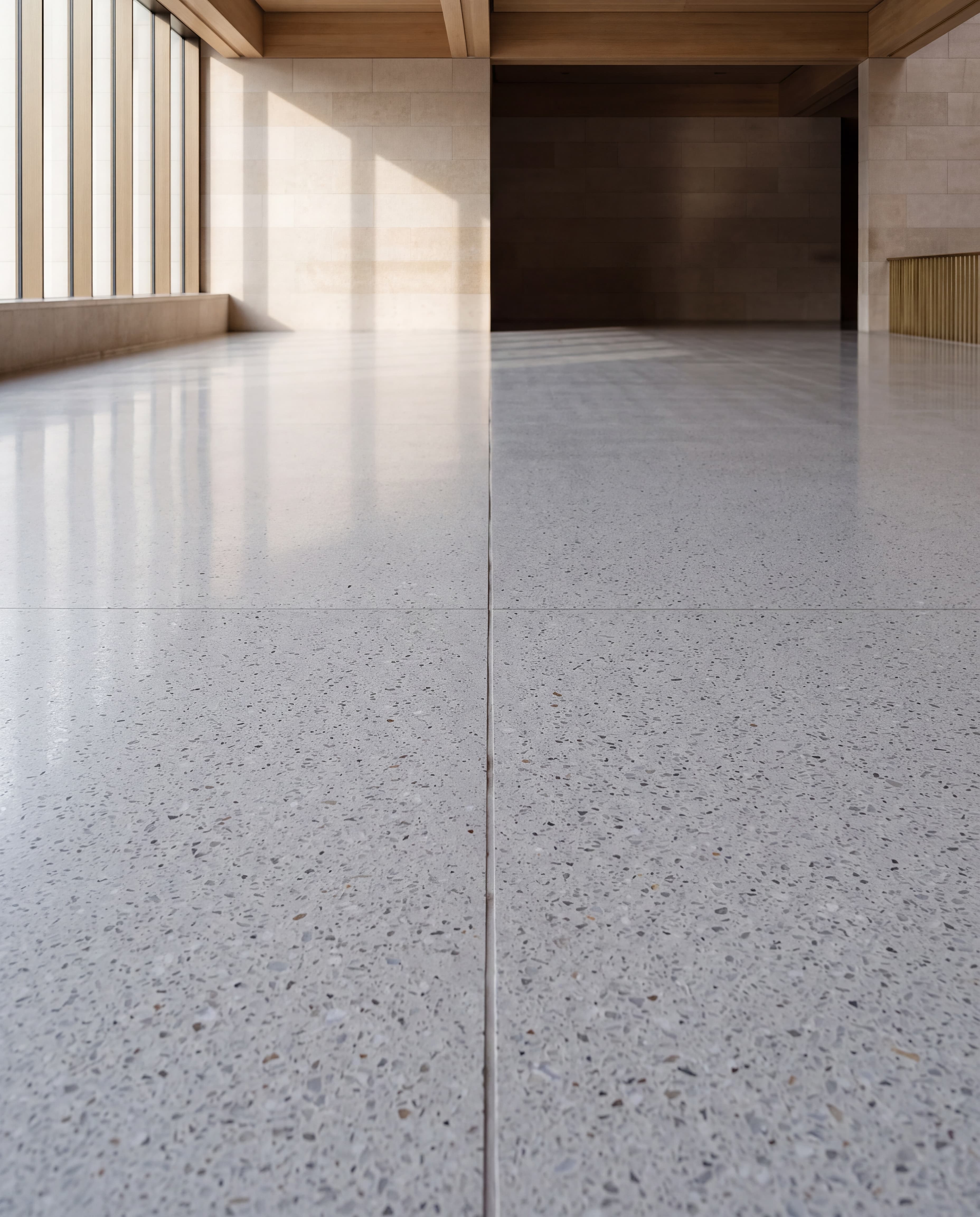
With natural stone the first thing to establish is whether the stone contains lime. Marble, travertine and limestone react to acidic bathroom and vinegar cleaners with dull etch marks; granite copes with them, but the grout slurried between the slabs does not. On stone we therefore stay neutral to mildly alkaline. On polished slabs an etch mark shows up at once because the shine is missing in patches; on honed stone it goes unnoticed and slowly spreads into a pale walking line.
Typical work
Suitable for
- Flats with parquet, floorboards or design coverings
- Offices and practices with linoleum or vinyl
- Retail and showroom areas with porcelain stoneware
- Kitchens and bathrooms with darkened grout
- Areas where the wrong product has been used
Typical work
- Identifying covering and finish before work starts
- Dry pre-cleaning so grit cannot act as an abrasive
- Damp mopping at a measured dosage suited to the floor
- Targeted work on grout in kitchen and bathroom
- Edges, transitions and skirting areas by hand
- A clear-water pass against residue on sensitive coverings
- Drying off wood and click-system coverings
Possible add-ons
- Machine cleaning of large uninterrupted hard-floor areas
- Spot treatment of individual marks after a prior test
- Carpet and textile coverings in the same room, costed separately
- Recurring floor care on an agreed cycle
Possible intervals
- A single intensive appointment for one area
- Weekly in entrance and thoroughfare areas
- Every two to four weeks under normal use
- Additionally at the end of the road-salt season
What matters here
Vinyl and linoleum
Design coverings and vinyl come from the factory with a thin wear layer, usually reinforced with polyurethane. It tolerates neither scouring agents nor solvent-based cleaners; once it is rubbed through, dirt lodges in the soft backing underneath. More common than scratches, though, are plasticiser stains: rubber feet and anti-slip mats leave brownish rings that migrate into the covering. With click vinyl on a wood-fibre core there is a further risk: mop water travels through the click joints into the board.
Linoleum is often taken for PVC, yet it is made from linseed oil, resin and cork flour. Strongly alkaline cleaners saponify that binder: the floor first turns dull, later brittle. So we work with neutral products and little water, because the jute backing on the underside also absorbs moisture. A yellowish veil after the floor has been covered for a while, by contrast, is not damage but drying-room yellowing – it fades away by itself in daylight.
Grout and dosage
Grout lines show why the choice of product is no minor detail. Cement grout is absorbent: an acidic cleaner dissolves the limescale but attacks the joint along with it, leaving it open and dark over the years; grease, on the other hand, only comes off with an alkaline product. And more cleaner does not clean better – dosage is measured in millilitres per litre, not by feel. Overdosing without a clear-water pass leaves a surfactant film that traps dust and streaks at the next wipe.
Price
- per worker and working hour
- Price on requestper worker and working hour
- travel per working day — not per person
- Price on requesttravel per working day — not per person
- site visit, only if booked separately and without an order
- Price on requestsite visit, only if booked separately and without an order
What a working hour means
Billing is per person on site and per hour worked. Two people working three hours makes six working hours.
Assuming: 150 m² of tiled floor in a commercial space – machine cleaned, joints treated as well.
- Price on request
- Travel costs, once per working day
- Price on request
- Price on request
A different property gives a different figure. The arithmetic stays the same.
How it works
Send your request
Choose whichever way of getting in touch suits you best.
Establish what is needed
We look at area, condition, timing, materials and any special requirements.
Confirm clearly
You receive a personal response and transparent terms.
Work to the list
We arrive at the confirmed time and work through the agreed service plan. If something does not get done, you hear it the same day.
Important limits
- No sanding and no resealing of parquet
- No laying or repair work on loose tiles and boards
- No renewal of damaged silicone or expansion joints
- No façade work, no façade cleaning, no winter road service
- Etch marks, scratches and worn-through wear layers stay visible
We deliberately stay within our field. What we cannot carry out safely and properly, we decline in advance rather than promise.
Frequently asked questions
Will dull patches in parquet become glossy again?
Not through cleaning. Once the seal has worn through, only sanding and resealing will help – that is joinery work and not part of what we offer. We remove films of dirt and old care products and tell you whether the dull patch came from those or from worn lacquer.
How do you estimate the time required?
Not from square metres alone. Every additional type of covering costs time, because product, dosage and mop head all have to be changed. Four coverings across a hundred square metres take longer than a single one across two hundred. Price on request.
Can I use a steam cleaner?
On glazed porcelain stoneware, usually yes. On parquet, laminate, vinyl and linoleum, no: hot steam forces moisture into the joints and can soften the adhesive under glued-down coverings. On impregnated natural stone it breaks down the protective layer.
Can individual stains be removed?
That depends on whether the stain sits on the covering or inside it. Rubber marks, coffee and grease usually come off. Plasticiser migration, etch marks and oil drawn into open-pored stone stay visible. We test in a hidden spot and say beforehand what is achievable.
Do you work by machine or by hand?
It depends on the area and its layout. Large uninterrupted hard floors come out more evenly by machine, but that needs power, a water point and a clear run. Awkward rooms, steps and everything up to the skirting stay hand work. Usually we combine the two in one appointment.
Goes well with
Carpet cleaning in Munich
Carpets and carpeting cleaned gently – after checking fibre, backing and how they are laid.
Hotel cleaning in Munich
Rooms ready inside the turnaround window, everyone working the same sequence, release back to reception.
Event cleaning in Munich
Set-up, turnaround, final clean – the crew size follows the deadline, not the floor area.
Stairwell cleaning in Munich
Stairwells, handrails and entrance areas at fixed intervals – agreed with your property manager.
Who we typically do this for
Talk to us
Tell us the area, the condition and your preferred date. We will get back to you personally with a reliable estimate – usually the same day during our availability hours.