
Service Area · District 20
Cleaning in Hadern
Hadern is strongly shaped by its hospital. Practices, laboratories and therapy rooms have settled around it, and many of the people who work there live in the neighbouring schemes. For cleaning that means early in the morning and with fixed appointments, because in a medical setting nothing can wait.
For practices, the start of consulting hours governs the whole routine. Because many practices sit close together here and open early, the window is narrow. We plan the route through the rooms in advance and start where someone will be standing first: reception. Treatment rooms come last, and only once the team has cleared them.
A promise beyond that line would not merely be dishonest, it would be dangerous: a practice that believes a surface has been disinfected treats it differently from one that knows better. So our contracts state what is cleaned, not what is supposedly “taken care of along the way”.
How the district grew
Hadern was a small village west of Munich, with farms and fields. Little changed about that until the middle of the 20th century.
The turning point was the Großhadern hospital. For the large hospital complex and the people who would work there, the area was completely rebuilt in the 1960s and 1970s: housing schemes, roads, an underground connection, shops and schools.
So the district came about in one go rather than growing over generations: housing, streets, underground line, shops and schools were planned together. That explains why so much of it looks alike, and why the old village centre in the middle looks like a foreign body.
What you will find here
Buildings in the district
- 1960s and 1970s schemes with lifts and underground parking
- Several stairwells and long corridors per scheme
- Practices, laboratories and therapy rooms around the hospital
- Floors in screed, tile or cast stone – hard-wearing and easy to maintain
- Old village core with low houses and small plots
- Ancillary rooms: bicycle cellar, laundry, refuse room, lift lobby
What usually comes up
- Cleaning practices before the first consultation, with a fixed early slot
- Waiting rooms, reception and corridors – the surfaces everyone touches
- Stairwells and corridors in the schemes, on a fixed cycle
- Lift car interiors: floor, mirror, control panel, door reveal
- Sweeping and mopping refuse rooms, bicycle cellars and laundries
- Cleaning flats, regular or at move-out
Access and parking
- Around the hospital little is free during the day; in the schemes there is usually enough
- If we may use the underground car park, we save time at every visit
- Lifts are available in almost all the schemes
- Several entrances per scheme – we need a clear allocation in advance
- For practices we need a fixed slot before consulting hours
- Access to cellar, laundry and refuse room is often separately locked
What is different here
Waiting room and scheme
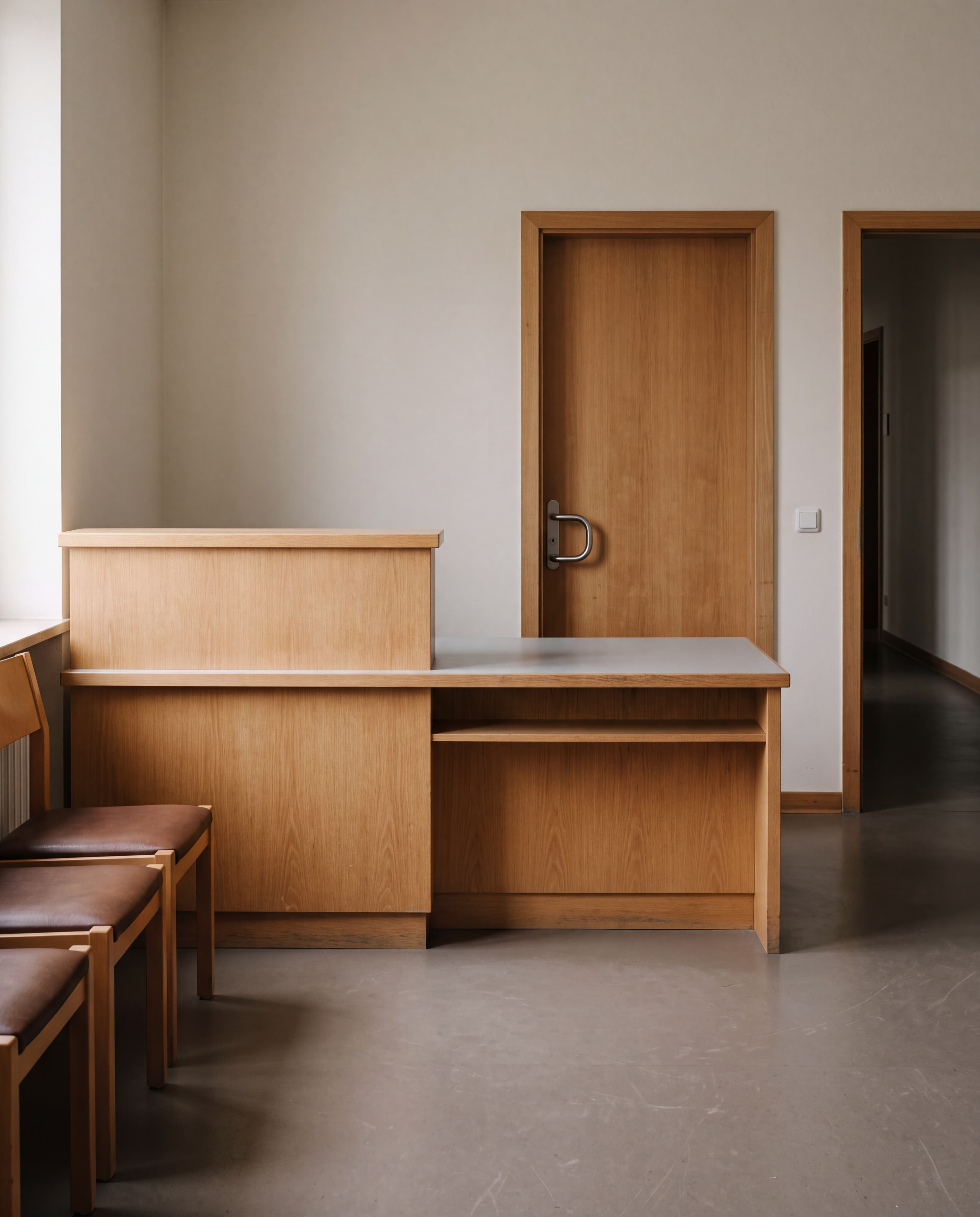
The waiting room is where most things get touched: door handles, chair backs, light switches, the reception counter. They are on the list at every visit, even when the floor looks more urgent. What lies on the tables stays there: magazines, toys, information leaflets. Your team knows where things belong; we do not.
In the housing schemes the effort lies not in the material but in the quantity: vinyl flooring and concrete stairs tolerate anything, but they come twelve times over. The mistake in schemes like these is therefore never the wrong product but a wrongly estimated number. We report what we notice and never extend the job on our own account.
The lift and the order
The lift is often overlooked and yet it is the most used surface in the building. In schemes near the hospital there is an extra factor: it runs around the clock, because shift work has no closing time. Control panel, floor and door reveal soil correspondingly fast. We include the car every cycle.
Around the university hospital, Hadern has a striking number of practices between its housing schemes. Both in one day usually works, but it needs a fixed order: the practice first, before surgery hours, the stairwell afterwards. The other way round turns the waiting room into a thoroughfare, and everyone sitting there notices.
Especially in demand here
Stairwell cleaning in Munich
Stairwells, handrails and entrance areas at fixed intervals – agreed with your property manager.
Maintenance cleaning in Munich
Recurring cleaning to a fixed service plan – each area on its own cycle.
Domestic cleaning in Munich
More time for what matters to you – as a one-off or regularly by calendar.
Holiday apartment cleaning in Munich
Turnovers in a tight window – fresh linen, restocked supplies, photos at the end.

Questions from this district
Can you come before consulting hours?
Yes, and for practices that is the norm. We agree a fixed early slot so you can rely on it. Our hours run Monday to Friday from 08:00.
Do you carry out disinfection to national guidelines?
No. We clean and treat contact surfaces. We do not carry out specialist medical disinfection – that requires a qualification we do not offer. We would rather say so up front than afterwards.
Can you take on several entrances of one scheme?
Yes. We need a list in advance: which entrances, how many storeys per entrance, and which ancillary rooms are included. We put it in writing so there is no argument later.
What does a visit in Hadern cost?
Price on request. Price on request. There is no minimum order value.

We come to Hadern
Tell us the property, its condition and your preferred date. We will get back to you personally.