
Service Area · District 11
Cleaning in Milbertshofen and Am Hart
In district 11 almost everything is large: the housing schemes, the office buildings, the space between them. Anyone needing cleaning here usually has several stairwells, long corridors and ancillary rooms to include. That makes the work easy to plan – provided the scope is fixed in advance.
With large properties an unclear scope nearly always surfaces in the same place: the bicycle cellar. It appears on no list of entrances, it is the dirtiest surface in the building, and each side assumes the other meant it. So we write it in explicitly – included or not, but named.
The floors in the district are almost all hard-wearing. Screed, tile and cast stone tolerate water and ordinary products. That makes the work simpler than in period buildings, but the area stays large – a fifty-metre corridor takes its time whatever the covering. We use equipment that covers ground while remaining carryable.
How the district grew
Milbertshofen was a village until industry settled on the northern edge of the city in the early 20th century. The best known firm is BMW, whose plant and headquarters are still in the district. Whole residential quarters were built for the workforce — first in the 1920s, then on a large scale after the war.
The second turning point was the 1972 Olympics. The Olympic Park and the Olympic Village went up on the former Oberwiesenfeld airfield. What was built to house athletes has been an ordinary residential quarter ever since — with footpaths on one level and cars on another.
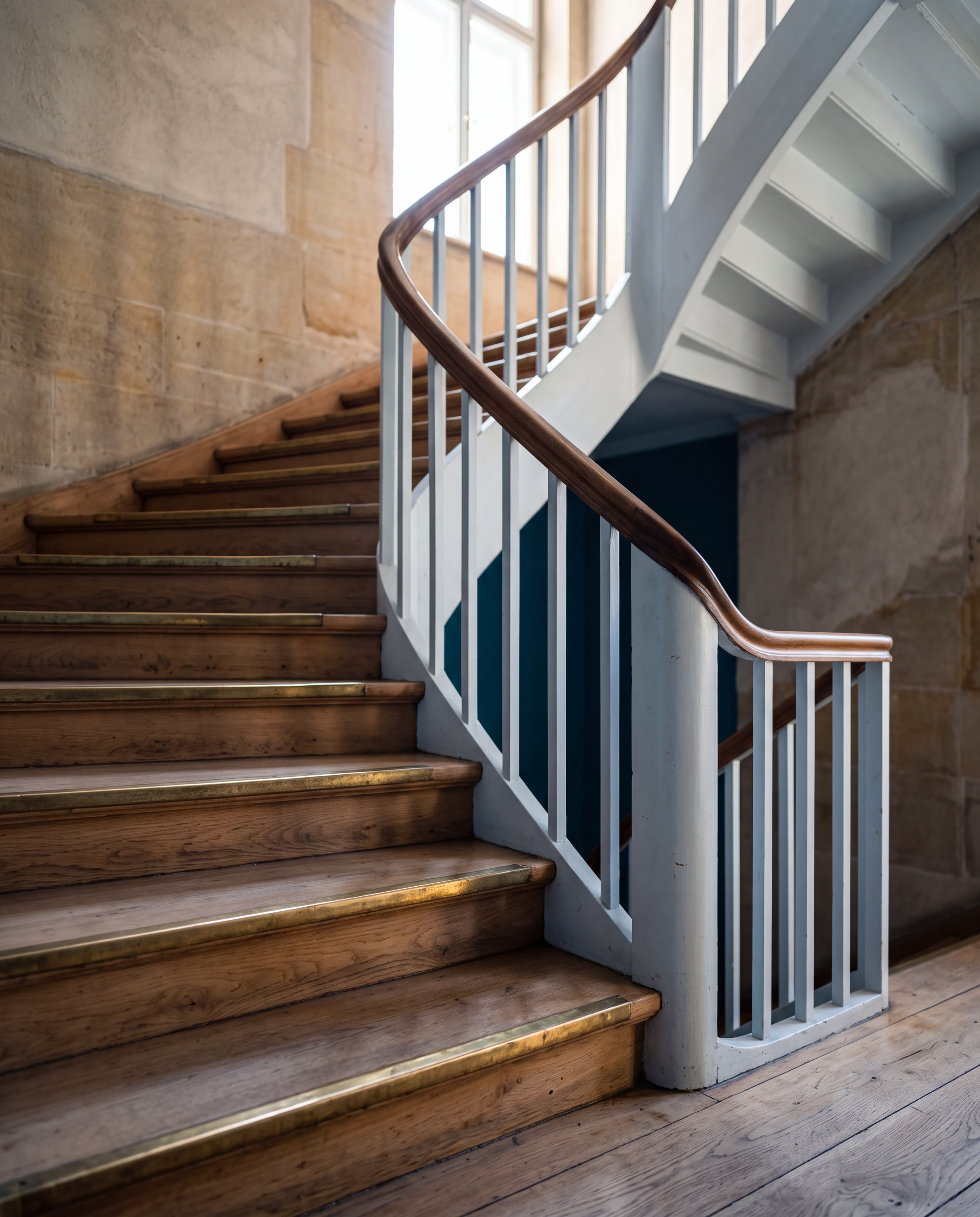
Am Hart, finally, consists mostly of housing estates from the 1950s to 1970s. Together that makes a district in which almost every building went up after 1920: lifts, underground parking, hard-wearing floors, large glazed areas.
What you will find here
Buildings in the district
- Large residential schemes of four to twelve storeys, with lifts and underground parking
- Several stairwells and long corridors per building
- Floors in screed, tile or cast stone, plus carpet tiles in offices
- Office and administrative buildings with large glazed façades
- Residential buildings from the 1920s with simple stairwells
- Ancillary rooms: bicycle cellar, laundry, refuse room, lift lobby
What usually comes up
- Stairwells and corridors on a fixed cycle, usually several per property
- Lift car interiors: floor, mirror, control panel, door reveal
- Office floors after hours, with carpet tiles and desks
- Entrance halls with glass, letterboxes and doorbell panels
- Sweeping and mopping refuse rooms, bicycle cellars and laundries
- Floor cleaning across large areas with portable equipment
Access and parking
- Parking is usually unproblematic here; many schemes have their own spaces
- If we may use the underground car park, we save time at every visit
- Lifts are available almost everywhere and help with the long routes inside
- Several entrances per scheme – we need a clear allocation in advance
- For office buildings we agree the arrangements for reception, barrier and alarm in advance
- One set of keys or a keypad code for all areas shortens every visit
What is different here
Lift and workstation
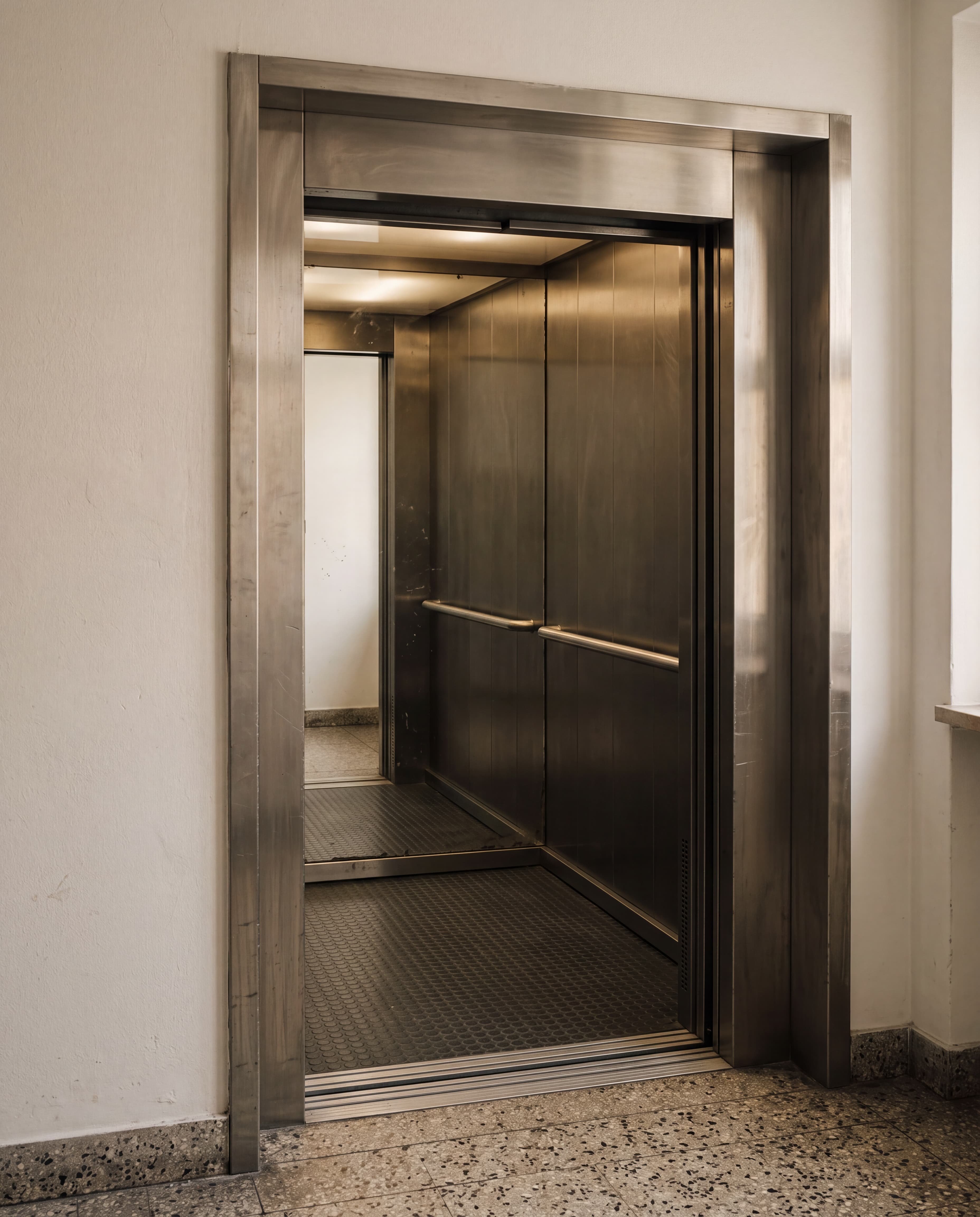
The lift car is the most used surface in the whole building and is still the one most often left out. The reason is the door reveal: it only shows when the doors stand open, and by then you are standing in the car yourself. So with us it is fixed in the scope, not left to judgement.
Papers lie on the desks, and we do not touch them: nothing is put away, nothing turned over, no surface with paper on it wiped. If a workstation is to be cleaned in full, it has to be clear by the evening – we put that in writing beforehand. Spray extraction of the carpet is a service of its own, not a side effect of the regular visit.
Refuse room and repetition
In the refuse room the limit of our job is closer than most people expect. We do not re-sort waste and we do not put bins out — that is for the waste service, and we are not permitted to. Anything lying there that does not belong we report to you in writing rather than clearing it away.
Anyone managing several properties here usually manages schemes from the same building period: the same layouts, the same stairwells, the same ancillary rooms. That is an advantage few people use – the time one scheme takes holds, with little deviation, for the next. So we survey the first one carefully and measure the rest against it.
Especially in demand here
Office cleaning in Munich
Clean workstations, well-kept shared areas and appointments that fit your working day.
Maintenance cleaning in Munich
Recurring cleaning to a fixed service plan – each area on its own cycle.
Floor cleaning in Munich
Every floor covering has its own rule – we establish it before the mop goes into the water.
Post-renovation cleaning in Munich
Lived-in rooms after painting, flooring and plumbing work – cleaned room by room, furniture and textiles included.
Questions from this district
Can you take on several entrances of one scheme?
Yes, that is the norm here. We need a list in advance: which entrances, how many storeys per entrance, and which ancillary rooms are included.
Do you clean office carpets?
On the regular cycle we vacuum them. Spray extraction, where the carpet is cleaned wet, is agreed separately – it takes longer and the floor has to dry afterwards.
Do you work in the evening too?
Yes, until 20:00. For office space an after-hours slot usually makes more sense, because nobody is at their desk then.
What does a visit in district 11 cost?
Price on request. How long a property takes depends on entrances, storeys and ancillary rooms – we look at that beforehand. There is no minimum order value.
We come to Milbertshofen and Am Hart
Tell us the property, its condition and your preferred date. We will get back to you personally.